
Burst Pipe Water Damage Restoration — Fast Response, Full Recovery
Emergency Extraction, Structural Drying & Complete Restoration Across DC, MD & VA — IICRC-Certified, All Insurance Carriers
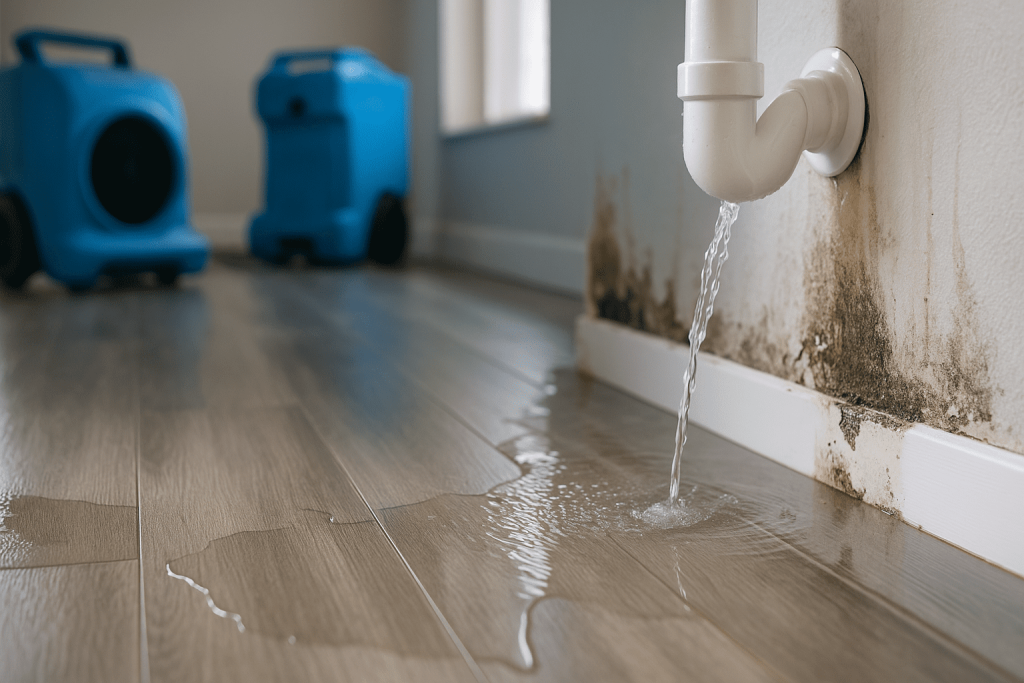
A burst pipe does not give you time — a failed supply line can release hundreds of gallons into your home’s wall cavities, subfloor, and adjacent rooms before the water reaches a surface where you can see it.
EZ Restoration Solutions responds to burst pipe water damage across DC, MD & VA within 60 minutes, 24 hours a day — locating the water that has already moved beyond the point of failure with thermal imaging, extracting it with commercial-grade equipment, and managing the complete structural drying and restoration process so the property comes back to exactly the condition it was in before the pipe failed.
IICRC-certified technicians. Licensed contractors for reconstruction. Full documentation for your insurance carrier from the moment we arrive.
How Burst Pipe Water Damage Spreads — And Why the First Hour Matters
Pipe failure water damage is not like water entering a structure from outside. A burst supply line is pressurised — which means water is not just flowing, it is being pushed into every gap and cavity the building offers. In the first minutes after a pipe fails, water enters wall assemblies, drops through ceiling planes, and reaches floor joists and subfloor before it pools visibly anywhere.
The pressure differential also means water travels further from the point of failure than most property owners expect. A pipe that bursts in a second-floor bathroom can introduce water into first-floor ceilings, wall cavities on the adjacent wall, and potentially the basement below — all before the failure is discovered. By the time visible water appears on a floor or ceiling, the interior damage is already significantly larger than the surface presentation suggests.
This is why burst pipe restoration begins with thermal imaging before extraction begins. Infrared cameras identify moisture inside walls, under flooring, and in ceiling cavities that have not yet presented at the surface. Treating only the visible wet area leaves the structural damage in place.
Burst Pipe Damage Patterns — What Gets Affected and How
The location of the pipe failure determines the damage pattern. Understanding these patterns is what drives accurate moisture mapping and equipment placement.
PIPE LOCATION | PRIMARY DAMAGE PATTERN | SECONDARY RISK |
Upper floor supply line or fixture | Water descends through the ceiling into the floor assembly below. Saturates ceiling drywall, floor joists, and subfloor on the level underneath. | If water reaches the basement or crawl space, below-grade materials absorb moisture from above — often missed without thermal imaging. |
Interior wall supply line | Water travels along framing members and saturates insulation and drywall paper facing inside the wall cavity. May not present at the surface for hours. | Wall cavity mold risk is elevated when saturation goes undetected. Paper facing on drywall is the primary mold substrate. |
Exterior wall supply line | Cold-side exterior walls hold moisture longer due to lower ambient temperature. Freeze-thaw cycles may cause repeated failure at the same location. | Insulation replacement is frequently required — exterior wall batts absorb and retain moisture that cannot be dried in place. |
Under-slab or crawl space pipe | Water enters from below grade, saturating slab, subfloor, and lowest-level flooring from underneath. Often discovered late. | Extended saturation increases structural framing risk. Below-grade moisture is harder to extract and slower to dry. |
Ceiling or attic supply line | Water pools in ceiling assembly before gravity pulls it through. Ceiling drywall fails structurally when saturated weight exceeds load capacity. | If ceiling failure occurs, materials and contents below are exposed. Water migration into interior wall cavities is unpredictable. |
For Service in Your Area, Call Our Emergency Response Team
Emergencies can strike without warning, leaving your home or business unsafe and overwhelmed. Whether you’re dealing with a burst pipe, sudden flooding, or storm-related destruction, our team is ready to respond anytime, day or night.

Frozen Pipe Damage — Why the Risk Is Higher Than Most People Know
Frozen pipe damage follows a different timeline from a sudden pipe failure. When temperatures drop below freezing, water inside pipes — particularly pipes routed through unheated spaces like attics, exterior walls, and crawl spaces — begins to freeze and expand. The pipe does not fail during the freeze. It fails when the temperature rises and the ice inside melts. That is when property owners discover the damage — often hours or days after the failure actually occurred.
This delay between failure and discovery means frozen pipe water damage frequently involves longer saturation periods than pipe bursts from pressure spikes or mechanical failure. Materials that have been wet for twelve to twenty-four hours before extraction begins present a different drying challenge than materials that were wet for one or two hours. The scope of structural drying, and the risk of secondary mold development, increases with every hour the saturation goes unaddressed.
Pipe systems most vulnerable to freeze damage (C2 — Pipe-Specific Entity Cluster) Pipes routed through exterior walls with insufficient insulation. Attic supply lines where heat from the living space does not reach the pipe. Pipes in unheated crawl spaces or garage utility areas. Properties where the thermostat was set low during an absence. Older polybutylene or copper supply lines in buildings without adequate thermal protection on exterior-facing runs. At what temperature do pipes freeze? Pipes begin to freeze when sustained ambient temperatures around the pipe drop below 20°F (-6°C). A single cold night may not cause failure — but sustained temperatures below that threshold, particularly with wind chill affecting poorly insulated exterior wall cavities, significantly increases the risk. Pipe failures from freeze-thaw cycles are most common in the first thaw after an extended cold period. |
The Burst Pipe Restoration Process — From Shutoff to Full Recovery
Every burst pipe job follows the same professional sequence. What changes is the scope — determined by the pipe location, the duration of the failure before discovery, and how far the water traveled before extraction began.
Step 1 — Source Shutoff Confirmation (C4 — Response Protocol) Before any extraction equipment is placed, the water source must be isolated. We confirm the shutoff valve is closed and the supply is stopped. If the main water meter shutoff is required, we coordinate that step. Extraction against an active water source accomplishes nothing. Step 2 — Thermal Imaging and Moisture Mapping FLIR thermal imaging cameras scan all areas adjacent to and below the failure point. Moisture meters take baseline readings at every identified saturation area. This mapping drives equipment placement — not the visible wet zone, which is always smaller than the actual affected area. Step 3 — Emergency Water Extraction Commercial extraction equipment removes standing water and pulls residual moisture from carpet, subfloor, and surface materials. Portable units access wall cavities and confined areas that truck-mounted equipment cannot reach directly. Extraction is the prerequisite for effective structural drying. Step 4 — Structural Drying Deployment (C4 — IICRC S500 Protocol) Industrial LGR dehumidifiers and high-velocity air movers are placed according to the IICRC S500 drying protocol — engineered positioning based on the moisture map, not arbitrary placement near the visible damage. Daily moisture readings track drying progress at every documented measurement point. Step 5 — Material Assessment and Removal Materials that cannot be dried in place — drywall with full-thickness saturation, insulation that has absorbed beyond recovery, subfloor that has exceeded swelling thresholds — are removed to allow the structural framing to dry correctly and to prevent secondary mold from establishing inside enclosed cavities. Step 6 — Reconstruction After structural drying is confirmed complete with verified moisture readings, reconstruction begins. Drywall, flooring, insulation, cabinetry, and finish work are rebuilt to pre-loss condition. EZ Restoration Solutions manages remediation and reconstruction under one scope — no second contractor, no gap between what was removed and what is rebuilt. |
Commercial Burst Pipe Water Damage Restoration — DC, MD & VA
EZ Restoration Solutions responds to burst pipe water damage in commercial buildings, offices, retail spaces, restaurants, and multi-unit residential properties across the DMV region. Commercial pipe failures often involve larger volumes, multi-floor damage patterns, and tenant coordination requirements that residential jobs do not. Our IICRC-certified teams scale response to commercial scope and provide full documentation for commercial insurance claims. Call 866-676-5515 for commercial emergency response.
Pipe Burst. Call Now.
Pipe Burst. Call Now. Every minute a pipe is flowing, the damage footprint grows. Every hour it sits in your walls, the drying timeline lengthens. We respond in 60 minutes — 24 hours a day across DC, MD & VA. Free on-site assessment with thermal imaging. IICRC-certified team. Full insurance documentation. Toll Free: 866-676-5515DC: 202-816-7788 | MD: 240-570-7971 | VA: 703-997-2403 Info@ezrestorationsolutions.com Extraction. Drying. Reconstruction. One company — start to finish. |
Contact Our Emergency Response Team
Burst Pipe Insurance Claims — What Is Covered and What the Documentation Needs
Burst pipe water damage is one of the most commonly covered water damage events under standard homeowner’s insurance policies. Coverage is typically granted when the damage results from a sudden and accidental pipe failure — meaning the pipe failed without warning, not as a result of long-term neglect or deferred maintenance. Confirm your specific coverage with your carrier directly.
What insurance carriers require is documentation: the initial damage scope with photographs and moisture readings, the extraction and drying record, and confirmation of completion through a verified drying log. EZ Restoration Solutions provides all of this through the restoration process. Because remediation and reconstruction are managed by one company, the claim record is continuous — one scope of work, one company, no gap between the damage documentation and the rebuild estimate.
We work with adjusters at all major insurance carriers and can communicate findings and scope directly with your adjuster throughout the process.
Find the shutoff valve for the affected fixture or the main water meter shutoff and close it immediately. If you cannot locate the shutoff, the water meter shutoff is typically at the property boundary or in the utility room. Once the water is stopped, do not use electrical appliances or enter areas where water has reached electrical fixtures. Photograph the damage if it is safe to do so. Then call a professional — the damage is still spreading through wall cavities and subfloor even after the visible flow has stopped.
In most cases, yes — sudden and accidental pipe failures are a standard covered event under homeowner's insurance policies. Coverage is typically not extended to pipe failures resulting from long-term neglect, freezing in an unoccupied property where heat was not maintained, or gradual leaks. The documentation of the failure — timing, cause, scope of damage — is what supports the claim. EZ Restoration Solutions provides this documentation through the restoration process. Confirm your specific coverage with your carrier directly.
A pressurised supply line can release 600 to 800 gallons per hour depending on pipe diameter and line pressure. In a typical residential property, water from an upper-floor pipe failure can reach ceiling planes, interior wall cavities, the subfloor below, and ground-level rooms within minutes. Thermal imaging after a pipe failure consistently reveals moisture in areas 15 to 20 feet from the point of failure — often in locations where the surface appears completely dry.
A burst pipe refers to any sudden pipe failure that releases water — from pressure spikes, mechanical failure, corrosion, or impact. A frozen pipe is a specific cause: water inside the pipe freezes, expands, and splits the pipe wall. The failure in a frozen pipe typically occurs during the freeze but presents during the thaw, which means the discovery often comes hours or days after the pipe actually failed. Both events require the same restoration response, but frozen pipe events frequently involve longer saturation periods due to the delay in discovery.
Consumer fans and household dehumidifiers address surface air circulation. They do not penetrate into wall cavities, move air along subfloor assemblies, or create the conditions required to draw moisture out of structural materials. Without thermal imaging, you also cannot know whether the moisture inside your walls has been addressed. Professional structural drying uses industrial equipment positioned according to moisture mapping data and monitored with calibrated readings — the only process that produces a documented, verified drying outcome.
The drying phase typically takes three to seven days depending on the scope of saturation, the materials affected, and how quickly equipment was deployed. Reconstruction — replacing drywall, flooring, insulation, and finish work — adds three days to several weeks depending on the extent of material removal required. EZ Restoration Solutions provides a written timeline before reconstruction begins. The Structural Drying Completion Certificate closes the drying phase before any rebuild work starts.